

Based on our corporate philosophy, the TBK Group aims to contribute to the realization of a sustainable society and the enhancement of corporate value by ensuring that all employees address sustainability-related material issues through their business activities.
Sustainability Promotion Framework
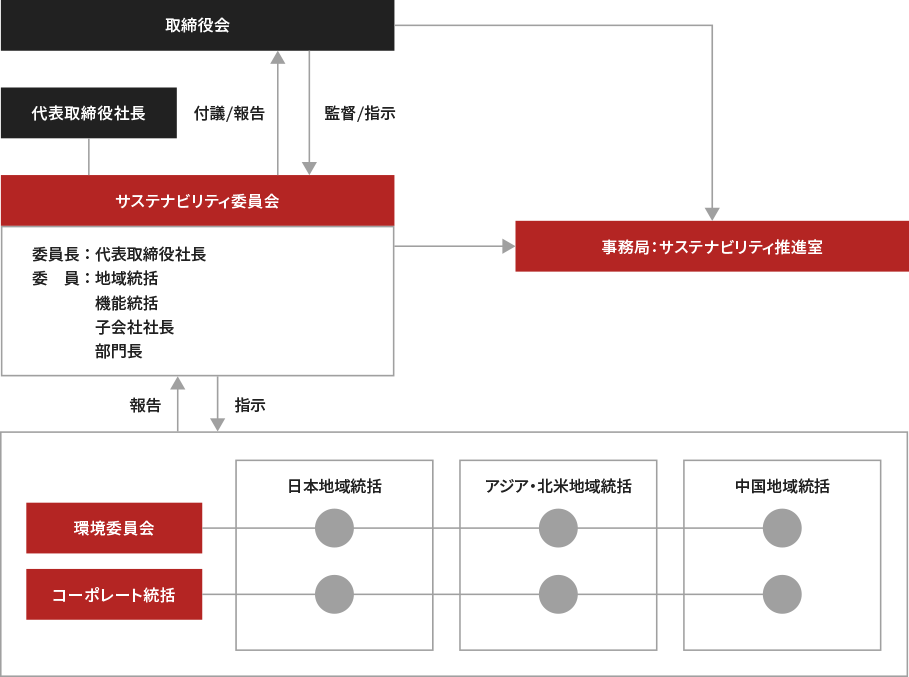
1.Establishment of the Committee
The TBK Group has identified “ESG Management Initiatives” as one of its key strategic priorities and is promoting sustainability across the entire organization.
To address material issues in a strategic and ongoing manner—and to link these efforts to the enhancement of the Group’s medium- to long-term corporate value—we have established the Sustainability Committee.
2.Role of the Committee
The committee is responsible for planning and formulating basic management policies, targets, and action plans related to sustainability. It also monitors progress, evaluates outcomes, and regularly reports to the Board of Directors.
Key issues and themes discussed by the committee are submitted to the Board of Directors for resolution and are then rolled out and promoted across all TBK Group locations.
3.Committee Composition
The committee is chaired by the President and CEO, with members consisting of the general managers of each headquarters and an Audit & Supervisory Board Member (Full-time).
TBK Group's Material Issues
The TBK Group has identified the following as its material (key) sustainability issues.
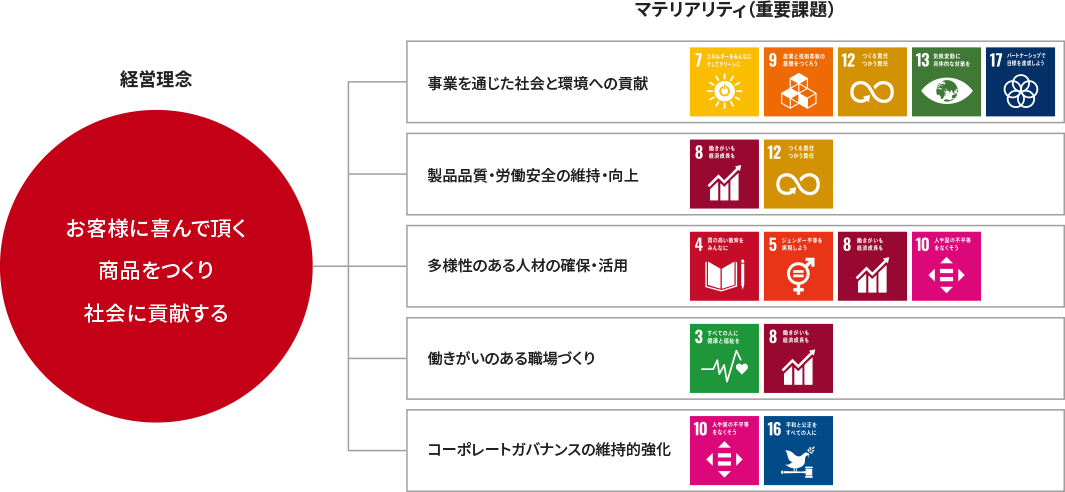
Materiality Identification Process
We identified relevant social issues by referencing global frameworks such as ISO 26000, the GRI Standards, and the SDGs, while also taking into account changes in the business environment and global megatrends.
These issues were then evaluated using a two-axis approach:
● Importance to our business, and
● Importance to external stakeholders such as investors, customers, and local communities.
Based on this evaluation, we created a Materiality Matrix.
From the matrix, issues with the highest relevance were selected as materiality candidates.
Finally, after discussions and approval by the Board of Directors, our material issues were formally identified.
Targets KPI
| Category | Material Issue | Key Indicator (KPI) | FY2024 Target | FY2024 Result |
|---|---|---|---|---|
| Environment (E) |
Contribution to society and the environment through business activities | Total CO₂ emissions | ▲15.0% compared to FY2013 | 21,981 t(Scope 1 & 2, all group companies in Japan) |
| Development of eco-friendly products (lightweighting, electrification) | Brake weight reduction | ▲15.0% weight reduction | ▲15.0% reduction in brake weight achieved (development activities) | |
| Social (S) |
Maintaining and improving product quality and workplace safety | - Number of major quality defects - Number of serious accidents | Target: Zero for both | Zero for both |
| Securing and utilizing a diverse workforce | - Ratio of female managers - Human resource development | Female manager ratio: 15.0% | Female manager ratio: 15.0% | |
| Creating a fulfilling and supportive workplace | Promotion of health management | Certified Health & Productivity Management Organization to be obtained | Certified Health & Productivity Management Organization obtained | |
| Governance (G) |
Sustaining and strengthening corporate governance | Evaluation of board effectiveness | 10% improvement in board effectiveness score | 7.8% improvement |
| Strengthening governance in Japan and overseas | - Implementation of regional headquarters system - Implementation of functional oversight system | Systems implemented | Implementation to begin in FY2025 |